
Introduction
Data science has moved far beyond research laboratories and specialised analytics teams. It is now being used in everyday software applications to personalise user experiences, predict business outcomes, automate decisions, detect unusual activities and extract useful information from large volumes of data.
For software developers and technology companies, this creates an important opportunity. Existing web, mobile, SaaS and enterprise applications can become significantly more intelligent when data science is integrated appropriately.
However, starting with data science can appear difficult.
The field includes programming, statistics, databases, visualisation, machine learning, artificial intelligence, cloud infrastructure and business analysis. Beginners often try to learn everything simultaneously or begin with advanced algorithms before understanding the problem they want to solve.
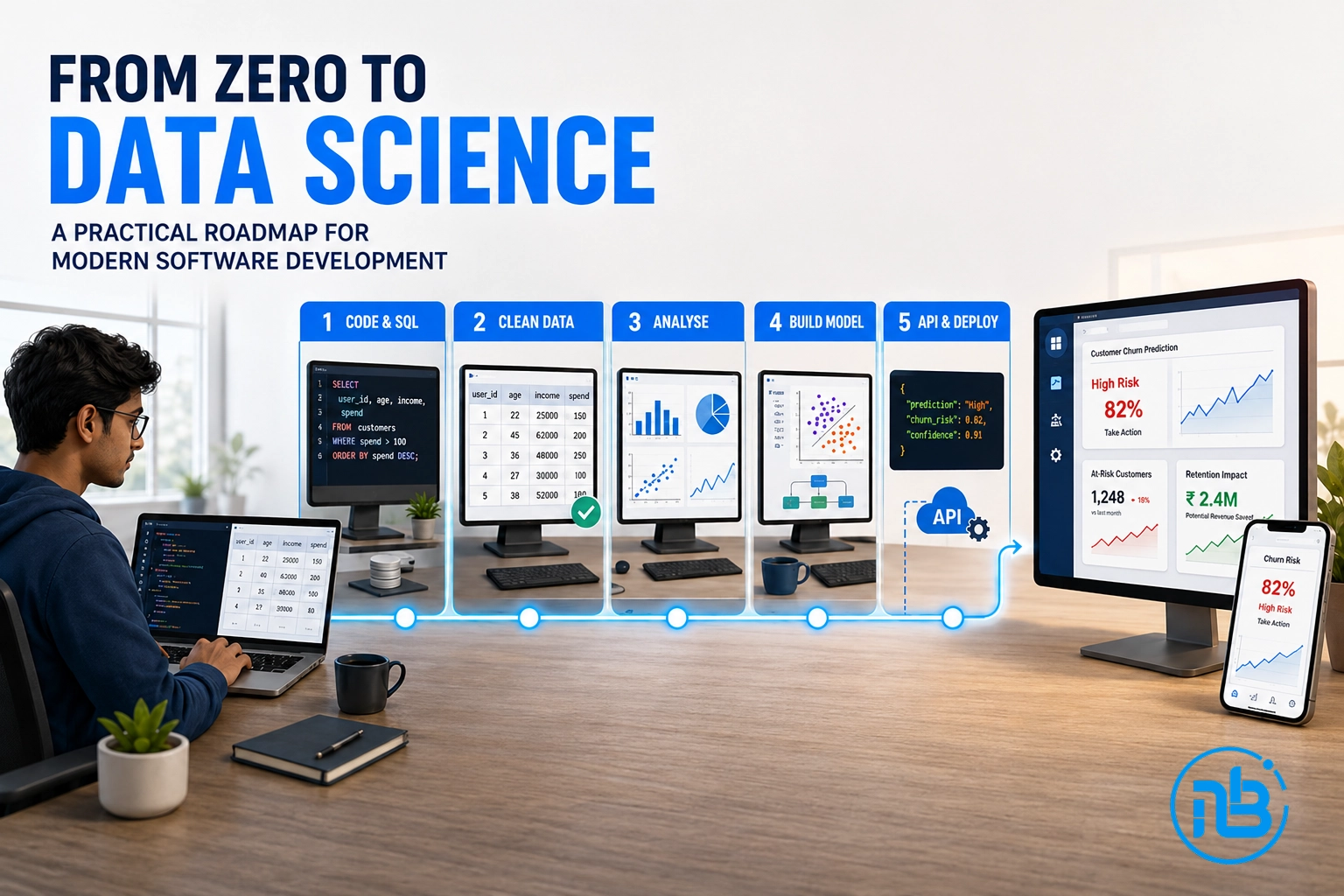
A better approach is to progress step by step—from understanding data to developing models and eventually deploying data-driven capabilities within real applications.
This article presents a practical roadmap for developers and organisations that want to begin from zero and gradually incorporate data science into their development work.
First, Understand What Data Science Actually Means
Data science is the process of collecting, organising, analysing and interpreting data to generate useful insights or support decisions.
It combines several disciplines:
- Software development
- Mathematics and statistics
- Data analysis
- Business and domain knowledge
- Machine learning
- Data visualisation
- Communication
Not every data-science project requires artificial intelligence or a complex machine-learning model.
Sometimes, the most valuable solution is a dashboard that clearly shows business performance. In another situation, it may be an automated report, a customer-segmentation tool, a recommendation engine or a system that detects unusual transactions.
The objective is not to use the most advanced algorithm. The objective is to solve a meaningful problem with data.
Start With a Business Problem, Not an Algorithm
One of the most common mistakes in data science is beginning with technology.
A team may decide that it wants to use machine learning without first identifying why it is required. This often produces a technically interesting solution with limited business value.
A data-science initiative should begin with clear questions such as:
- Which customers are likely to stop using our service?
- Which products are likely to have the highest demand next month?
- Which support tickets should receive immediate attention?
- Which transactions appear unusual or potentially fraudulent?
- What content should be recommended to a particular user?
- How long is a project likely to take?
- Which leads have the highest probability of conversion?
- What factors are affecting employee retention?
- Can repetitive document-review work be automated?
- Can we predict equipment or system failure?
A properly defined problem gives direction to the entire project.
Before development begins, establish:
- The business objective
- The decision the system should support
- The data required
- The expected users of the output
- The acceptable level of accuracy
- The risks of an incorrect prediction
- The measurable definition of success
Technology selection should happen only after these questions are answered.
Phase 1: Build the Programming Foundation
Python is one of the most widely used languages in data science because it is readable, flexible and supported by an extensive collection of data and machine-learning libraries.
A beginner does not need to master every aspect of Python before working with data. However, a solid understanding of the following concepts is essential:
- Variables and data types
- Conditional statements
- Loops
- Functions
- Lists, dictionaries, tuples and sets
- File handling
- Error handling
- Modules and packages
- Object-oriented programming fundamentals
- Virtual environments
- Working with APIs
Developers coming from PHP, JavaScript, Java or another language will already understand many of these programming concepts. Their primary task is to learn Python syntax and become familiar with its data-processing ecosystem.
The goal should be practical proficiency—not theoretical perfection.
Phase 2: Learn SQL and Database Fundamentals
Data science depends on data, and much of an organisation’s data is stored in databases.
A data scientist or developer working on data-driven applications should understand:
- SELECT queries
- Filtering and sorting
- Joins
- Grouping and aggregation
- Subqueries
- Common table expressions
- Window functions
- Database relationships
- Indexing fundamentals
- Data normalisation
- Query optimisation
SQL is often more important in everyday data work than advanced machine-learning algorithms.
A developer may spend a small amount of time building a model but a considerable amount of time locating, joining, validating and preparing the necessary data.
Experience with PostgreSQL, MySQL or another relational database provides a strong foundation. As projects become more advanced, developers can also explore data warehouses, NoSQL databases and cloud-based analytical platforms.
Phase 3: Learn How to Work With Data
Once the programming and database foundations are in place, the next step is learning how to inspect and manipulate data.
The most important Python libraries at this stage include:
- NumPy for numerical operations
- Pandas for tabular data analysis
- Matplotlib for basic visualisation
- Seaborn for statistical and analytical charts
A developer should learn how to:
- Import data from CSV, Excel, JSON, APIs and databases
- Inspect rows, columns and data types
- Identify missing values
- Remove duplicate records
- Correct inconsistent values
- Transform columns
- Combine multiple datasets
- Filter and aggregate records
- Create calculated fields
- Export cleaned data
This phase is known as data cleaning or data preparation.
In real-world projects, data is rarely perfect. It may contain missing information, incorrect formats, inconsistent spellings, duplicated records, impossible values or outdated entries.
A machine-learning model trained on poor-quality data will produce unreliable results, regardless of how sophisticated the algorithm may be.
Phase 4: Understand Essential Statistics
A developer does not need an advanced degree in mathematics to begin data science. However, certain statistical concepts are necessary to understand data and evaluate results correctly.
Important topics include:
- Mean, median and mode
- Minimum, maximum and range
- Variance and standard deviation
- Percentiles and quartiles
- Probability fundamentals
- Data distributions
- Correlation
- Sampling
- Confidence intervals
- Hypothesis testing
- Outliers
- Bias and variance
- Statistical significance
Statistics helps developers avoid incorrect conclusions.
For example, two variables may appear related without one causing the other. An average may hide significant differences between customer groups. A model may perform well on historical data but fail when applied to new cases.
The objective is not to memorise formulas. It is to understand what each measurement means and when it should be used.
Phase 5: Practise Exploratory Data Analysis
Exploratory Data Analysis, commonly known as EDA, is the process of examining data before building a model.
EDA helps answer questions such as:
- What information is available?
- Which variables are important?
- Are values missing?
- Are there unusual records?
- Which patterns are visible?
- Are variables related?
- Is the available data sufficient?
- Are certain groups underrepresented?
- Could the data contain bias?
An effective EDA process normally includes:
- Understanding the dataset
- Reviewing data quality
- Generating summary statistics
- Examining individual variables
- Comparing relationships between variables
- Identifying patterns and outliers
- Visualising key findings
- Recording assumptions and limitations
EDA is not merely preparation for machine learning. It can produce valuable business insights independently.
A company may discover through analysis that most customer complaints originate from one process, that sales decline during a particular period or that a specific user group has a much higher retention rate.
Phase 6: Begin With Simple Machine-Learning Models
After learning to prepare and analyse data, developers can begin machine learning.
Machine learning can broadly be divided into several categories.
Supervised Learning
The model learns from historical data where the expected outcome is already known.
Common use cases include:
- Predicting prices
- Forecasting sales
- Classifying support tickets
- Predicting customer churn
- Detecting fraudulent transactions
- Estimating project timelines
Popular supervised-learning algorithms include:
- Linear regression
- Logistic regression
- Decision trees
- Random forests
- Support vector machines
- K-nearest neighbours
- Gradient-boosting algorithms
Unsupervised Learning
The model works with data that does not have predefined outcome labels.
Common applications include:
- Customer segmentation
- Grouping similar products
- Identifying behavioural patterns
- Detecting unusual records
- Reducing the number of data dimensions
Popular techniques include:
- K-means clustering
- Hierarchical clustering
- Principal Component Analysis
- Anomaly-detection algorithms
Beginners should start with simple models.
A complex model is not automatically better. Simpler models are often easier to explain, faster to train, less expensive to operate and more appropriate for business use.
Phase 7: Learn to Evaluate Models Correctly
Developing a model is only one part of the process. The model must be evaluated to determine whether it is reliable enough for its intended use.
The data should generally be divided into:
- Training data
- Validation data
- Testing data
The model learns from the training data. Validation data supports tuning and comparison. Testing data measures performance on information the model has not previously seen.
Depending on the problem, evaluation measurements may include:
- Accuracy
- Precision
- Recall
- F1-score
- Confusion matrix
- Mean Absolute Error
- Mean Squared Error
- Root Mean Squared Error
- R-squared
- Area Under the ROC Curve
The appropriate metric depends on the business impact.
Consider a healthcare-screening system. Missing a genuine high-risk case may be more dangerous than flagging an additional case for human review. In that situation, recall may be more important than overall accuracy.
For a fraud-detection system, both false positives and false negatives can create costs. The team must select metrics according to actual operational consequences.
Phase 8: Build a Small End-to-End Project
Courses and tutorials are useful, but real learning begins when developers complete an entire project.
A strong beginner project should include:
- Problem definition
- Data collection
- Data cleaning
- Exploratory analysis
- Feature selection
- Model development
- Evaluation
- API integration
- User-interface presentation
- Documentation
Suitable starter projects include:
- Customer churn prediction
- Sales forecasting
- Product recommendation
- Employee attrition analysis
- Support-ticket classification
- Lead-scoring systems
- Property-price prediction
- Inventory-demand forecasting
- Basic anomaly detection
The project does not need to be large. It should demonstrate the complete journey from raw data to a usable result.
Phase 9: Integrate Data Science Into an Application
A model stored in a notebook is not yet a business solution.
To create value, its output must be integrated into an application or workflow.
A common architecture is:
Web or Mobile Application
        ↓
Backend Application
        ↓
Data Science API
        ↓
Trained Model
        ↓
Prediction or Recommendation
        ↓
Database and User Interface
Python frameworks such as FastAPI can expose a trained model through an API.
For example, a ReactJS or NextJS application may send customer information to a FastAPI endpoint. The API processes the information through a model and returns a risk score or recommendation. The frontend then displays the result to an authorised user.
This structure allows different technology components to work together:
- ReactJS or NextJS for the frontend
- NodeJS, Laravel or another framework for core business functionality
- Python and FastAPI for the data-science service
- PostgreSQL or MySQL for structured data
- Cloud storage for files and datasets
- AWS or Google Cloud Platform for deployment
The data-science component should complement the existing application architecture rather than unnecessarily replacing it.
Phase 10: Design for Production, Not Just Demonstration
A model that performs well on a developer’s computer may face several challenges in production.
A production-ready data-science system must consider:
- API security
- Authentication and authorisation
- Response time
- Concurrent requests
- Data validation
- Error handling
- Logging
- Model versioning
- Infrastructure cost
- Scalability
- Backup and recovery
- Privacy
- Regulatory compliance
Developers must also consider what happens if the model is unavailable.
Critical business workflows should have a fallback mechanism. A prediction should not prevent the entire application from functioning unless the prediction is essential and appropriate controls exist.
Model output should also be presented carefully. A probability or recommendation should not always be displayed as an absolute fact.
Phase 11: Introduce MLOps
Traditional software may continue behaving consistently until its code or environment changes. Machine-learning systems can lose effectiveness even when their code remains unchanged.
This can happen because real-world behaviour and data patterns change over time.
For example:
- Customer preferences may change
- Fraud techniques may evolve
- Market conditions may shift
- New products may be introduced
- User behaviour may change
- Data collection methods may be modified
MLOps applies structured engineering practices to the machine-learning lifecycle.
It includes:
- Dataset versioning
- Experiment tracking
- Automated model training
- Model version control
- Deployment pipelines
- Performance monitoring
- Data-drift detection
- Model-drift detection
- Scheduled retraining
- Rollback mechanisms
- Audit records
MLOps should be introduced gradually. A small internal project may not require a complex platform, but every production model should have basic versioning, monitoring and retraining plans.
Phase 12: Move Toward AI and Advanced Data Science
After developing strong foundations, teams can gradually explore more advanced areas such as:
- Natural Language Processing
- Computer vision
- Time-series forecasting
- Deep learning
- Recommendation systems
- Generative AI
- Large Language Models
- Document intelligence
- Speech processing
- Predictive maintenance
- Real-time anomaly detection
However, advanced technology should still follow the same fundamental process:
- Define the problem
- Validate the data
- Establish a simple baseline
- Evaluate business value
- Control risks
- Integrate the solution
- Monitor performance
- Improve continuously
An advanced AI model is not useful if it cannot be trusted, explained, operated or maintained.
Data Privacy, Security and Ethical Responsibility
Data-science systems can affect customers, employees and business decisions. Responsible development is therefore essential.
Teams should consider:
- Whether the organisation has permission to use the data
- Whether personal information is adequately protected
- Whether sensitive fields are necessary
- Whether the data contains historical bias
- Whether certain groups are unfairly represented
- Whether users understand how automated decisions are made
- Whether human review is required
- How long the data should be retained
- How model decisions can be audited
Sensitive information should be encrypted and access should be restricted according to roles and responsibilities.
The objective is not only to build an accurate system. It is to build one that is secure, fair and responsible.
A Practical Learning Roadmap
A developer starting from zero can follow this sequence:
Stage 1: Foundations
- Learn Python fundamentals
- Learn SQL
- Understand databases
- Practise Git and version control
Stage 2: Data Analysis
- Learn NumPy and Pandas
- Clean real datasets
- Explore data with Matplotlib and Seaborn
- Learn fundamental statistics
Stage 3: Machine Learning
- Understand supervised and unsupervised learning
- Practise with Scikit-learn
- Build simple baseline models
- Learn model-evaluation techniques
Stage 4: Application Integration
- Save and load trained models
- Create APIs using FastAPI
- Connect predictions to a web or mobile application
- Store results in a database
Stage 5: Cloud and Deployment
- Learn Docker fundamentals
- Deploy APIs and models
- Use AWS or Google Cloud Platform
- Implement logs and monitoring
Stage 6: Advanced Capabilities
- Study deep learning
- Explore NLP and computer vision
- Learn generative AI and LLM integration
- Introduce MLOps and automated retraining
Progress should be measured through completed projects, not only completed courses.
Common Mistakes to Avoid
Beginning With an Overly Complex Project
A small, complete project provides more learning than an ambitious project that is never completed.
Ignoring Data Quality
A sophisticated model cannot compensate for inaccurate or incomplete data.
Measuring Only Accuracy
The selected metric must reflect the actual business objective and risk.
Training on Confidential Data Without Controls
Data access, privacy and security requirements must be established before experimentation.
Keeping the Model Inside a Notebook
A model creates business value only when it is integrated into a usable workflow.
Ignoring Maintenance
Production models need monitoring, versioning and periodic retraining.
Replacing Human Decisions Unnecessarily
In many situations, the model should assist a professional rather than make the final decision.
Using AI Only for Marketing
A feature should not be described as AI-powered unless artificial intelligence genuinely contributes to its functionality.
How Organisations Can Begin
An organisation does not need a large data-science department to get started.
It can begin with a controlled pilot:
- Select one meaningful business problem
- Identify available data
- Assess data quality
- Build a simple analytical baseline
- Develop a small prototype
- Compare the outcome with the existing process
- Measure time, cost and accuracy improvements
- Collect user feedback
- Decide whether to expand
The first project should be valuable but manageable. It should not involve the organisation’s highest-risk decision or most sensitive data.
A successful pilot helps stakeholders understand both the potential and limitations of data science.
The Notebrain Approach
At Notebrain Software and Services Private Limited, we believe data science should be integrated into software development with a clear understanding of business requirements.
Our broader capabilities across ReactJS, NextJS, NodeJS, Python, FastAPI, mobile development, AI and machine learning, AWS and Google Cloud Platform allow data-driven services to be connected with practical web, mobile, SaaS and enterprise applications.
The focus should not be on building an isolated model. It should be on developing a complete solution that includes:
- Business workflow
- Data collection
- Analysis
- Model development
- API integration
- User experience
- Security
- Deployment
- Monitoring
- Continuous improvement
This end-to-end approach turns data science from an experiment into a usable business capability.
Start Small, but Build With Purpose
The journey into data science does not begin with artificial intelligence, deep learning or a complex predictive model.
It begins with curiosity about data and a clearly defined problem.
Learn Python. Understand SQL. Work with imperfect datasets. Develop analytical thinking. Build simple models. Evaluate them honestly. Integrate them into applications. Deploy them responsibly. Monitor their performance and improve them over time.
Developers do not need to abandon their existing skills to enter data science. Their understanding of application architecture, APIs, databases, security and user experience gives them an important advantage.
Data science becomes most valuable when it is combined with good software engineering.
The right goal is not to become an expert in every area immediately. The goal is to take one complete problem from raw data to a reliable, usable solution.
That is how a developer moves from zero to data science—and from conventional software development to intelligent, data-driven applications.