
Quick Takeaways
Before diving into the details, here are the key things you should know about Headless Shopify.
- Headless Shopify separates the storefront from Shopify’s backend.
- Shopify still manages products, inventory, checkout, payments, and orders.
- Developers gain complete freedom to build custom shopping experiences.
- Modern frameworks like React.js, Next.js, and Shopify Hydrogen power the frontend.
- A headless architecture can improve performance, flexibility, and scalability when implemented correctly.
- It isn’t the right solution for every business, but it can be transformative for growing brands with complex requirements.
Introduction
Every successful eCommerce business reaches a point where growth brings new challenges.
What started as a simple online store gradually evolves into something much bigger. Marketing teams want interactive landing pages, designers push for unique customer experiences, developers look for more flexible technologies, and customers expect websites to load instantly regardless of the device they’re using.
For many businesses, these growing expectations expose the limitations of a traditional storefront. That’s where Headless Shopify enters the conversation.
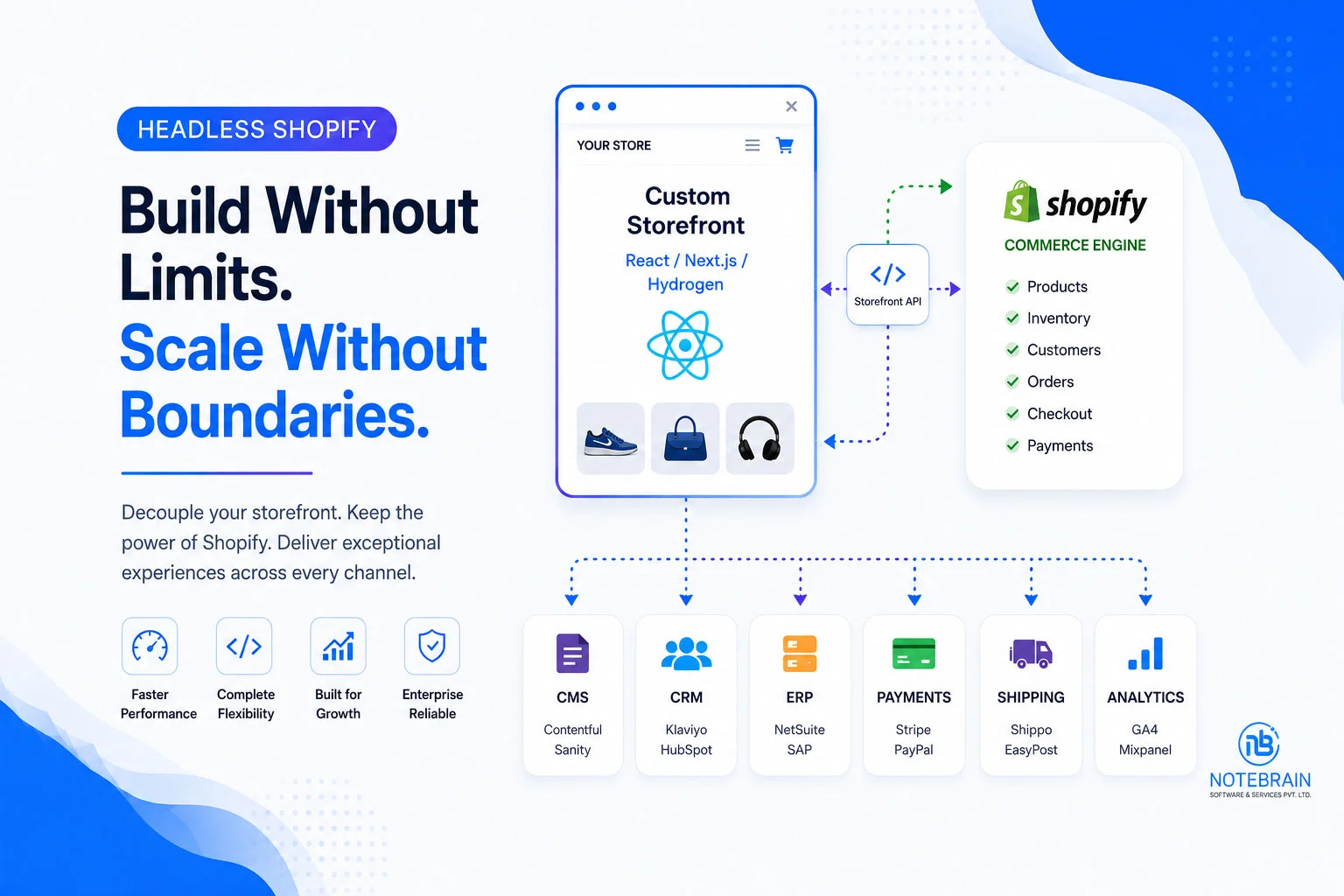
Instead of treating your website and your commerce platform as one tightly connected system, Headless Shopify separates them into two independent layers. The frontend, the part your customers interact with, is built using modern frameworks like React.js, Next.js, or Shopify Hydrogen. Meanwhile, Shopify continues to handle everything it already does exceptionally well, including product management, inventory, checkout, payments, and order processing.
This separation gives businesses much greater freedom to innovate.
- Want to redesign your storefront without affecting backend operations? You can.
- Planning to launch a mobile application alongside your website? The same Shopify backend can power both.
- Looking to integrate AI-powered search, personalized recommendations, or a custom CMS? Headless architecture makes those integrations significantly easier.
However, Headless Shopify isn’t a magic solution.
It introduces additional complexity, requires experienced developers, and often involves a higher upfront investment. For many businesses, a traditional Shopify store remains the smartest choice. The key is understanding which approach best aligns with your business goals.
In this guide, we’ll explain how Headless Shopify works, where it delivers the greatest value, and how to determine whether it’s the right architecture for your next stage of growth.
What is Headless Shopify?
To understand Headless Shopify, it’s helpful to first understand how a traditional Shopify store works.
In a standard Shopify implementation, the frontend and backend are tightly connected. The storefront is built using Shopify’s Liquid templating language, while Shopify manages products, customers, orders, inventory, checkout, and payments behind the scenes.
This architecture works extremely well for most online stores because it’s simple, reliable, and easy to manage.
Headless Shopify takes a different approach. Instead of using Shopify’s theme engine to display products and pages, developers build a completely custom frontend using modern JavaScript frameworks. This custom storefront communicates with Shopify using APIs, allowing it to retrieve products, collections, customer information, and shopping cart data in real time.
You keep Shopify’s powerful commerce engine while gaining complete freedom to create unique digital experiences for your customers.
Key Components of Headless Shopify
A modern Headless Shopify solution typically consists of five core components.
Custom Frontend
The customer-facing experience is built using frameworks such as:
This layer controls everything customers see and interact with.
Shopify Backend
Shopify continues managing:
- Products
- Inventory
- Customers
- Orders
- Discounts
- Checkout
- Payments
Businesses retain all the benefits of Shopify’s mature commerce platform.
Storefront API
The Storefront API acts as the bridge between the frontend and Shopify.
Whenever customers browse products, search collections, or update their cart, the frontend requests that information through the API.
Content Management System (CMS)
Many businesses combine Headless Shopify with a headless CMS such as Sanity or Contentful to manage landing pages, blogs, and marketing content more efficiently.
Cloud Infrastructure
The frontend is typically hosted independently using platforms such as:
This enables faster deployments, better scalability, and improved performance.
Why Businesses Are Moving to Headless Shopify
Businesses rarely adopt Headless Shopify because it’s trendy. They adopt it because their business requirements have evolved.
As brands grow, their expectations change. Marketing campaigns become more sophisticated, customer journeys become more complex, and digital experiences begin to play a larger role in purchasing decisions.
Headless Shopify helps businesses meet these new expectations without replacing the commerce platform they already trust. Here are some of the biggest reasons companies choose a headless architecture.
Complete Creative Freedom
Traditional themes provide structure, but that structure can sometimes become restrictive.
With Headless Shopify, developers can build completely unique shopping experiences tailored to the brand’s identity and customer journey. Whether it’s interactive product configurators, immersive storytelling, or advanced animations, businesses aren’t limited by the capabilities of a theme.
Faster User Experiences
Customers notice when a website feels fast. Modern frameworks support techniques such as Server-Side Rendering (SSR), Static Site Generation (SSG), image optimization, and intelligent caching, creating smoother browsing experiences across all devices.
Omnichannel Commerce
Today’s customers move seamlessly between websites, mobile apps, social platforms, and physical stores.
A Headless Shopify architecture enables all these channels to share the same commerce backend, ensuring consistency across products, pricing, inventory, and customer data.
Easier Integrations
Growing businesses rely on numerous business systems including CRMs, ERPs, payment gateways, shipping providers, and marketing platforms.
An API-first architecture makes integrating these systems significantly easier.
Future Scalability
Perhaps the greatest advantage of Headless Shopify is flexibility. As your business evolves, you can continue improving the customer experience without rebuilding the entire platform.
How Headless Shopify Works

At first glance, Headless Shopify may sound like a complex technical concept. In reality, the architecture is surprisingly straightforward once you understand the role of each component.
Think of it as separating how your store looks from how your store operates.
Your storefront focuses entirely on delivering a great customer experience, while Shopify quietly manages everything related to commerce in the background.
Let’s walk through a typical customer journey.
Step 1: A Customer Visits Your Website
Unlike a traditional Shopify store that renders pages using a Liquid theme, a Headless Shopify website is powered by a custom frontend built with frameworks such as:
- React.js
- Next.js
- Shopify Hydrogen
This frontend is usually hosted independently on cloud platforms like Vercel, Netlify, or AWS.
Your development team has complete control over how every page is rendered, optimized, and presented to the customer.
Step 2: The Frontend Requests Data from Shopify
When a customer opens a product page, the website doesn’t contain that product information itself.
Instead, it requests the information from Shopify through the Storefront API.
The API returns data such as:
- Product Name
- Description
- Images
- Variants
- Pricing
- Availability
- Customer Reviews (if integrated)
This happens almost instantly, creating a seamless browsing experience.
Step 3: Customers Browse Products
Every interaction continues through APIs.
When a customer Searches for a product / Applies filters / Adds an item to the cart / Signs into their account, the frontend communicates with Shopify behind the scenes.
To the customer, it feels like one fast, responsive website. Behind the scenes, several services are working together.
Step 4: Shopify Handles Checkout
One of Shopify’s biggest advantages is its secure checkout. Even in a Headless architecture, most businesses continue using Shopify Checkout.
That means you still benefit from:
- Secure payment processing
- PCI compliance
- Tax calculations
- Shipping logic
- Discount management
- Fraud protection
- Order management
This allows businesses to customise the storefront without rebuilding one of the most critical parts of the purchasing journey.
Step 5: Third-Party Systems Stay in Sync
After an order is placed, Shopify can automatically communicate with other business systems. Common integrations include:
- ERP
- CRM
- Accounting Software
- Shipping Providers
- Email Marketing Platforms
- Inventory Systems
- Analytics Tools
This creates a connected commerce ecosystem where information flows automatically between systems, reducing manual work and improving operational efficiency.
Headless Shopify Architecture

One of the biggest strengths of Headless Shopify is its modular architecture. Instead of building everything inside a single application, each layer has a clearly defined responsibility.
This makes the platform easier to scale, maintain, and evolve over time. At a high level, the architecture consists of five layers.
Customer Layer
Customers interact with your brand through:
- Desktop Website
- Mobile Website
- Mobile App
- Tablet
- Smart Devices
Regardless of where the customer enters, they’re connected to the same commerce backend.
Presentation Layer
This is your custom storefront.
Built using:
- React.js
- Next.js
- Shopify Hydrogen
Its only responsibility is creating an outstanding customer experience.
API Layer
The frontend communicates with Shopify using:
- Storefront API
- Admin API
- GraphQL
These APIs retrieve products, collections, inventory, customer accounts, and shopping cart information.
Commerce Layer
Shopify remains responsible for everything related to ecommerce. Including:
- Products
- Inventory
- Pricing
- Discounts
- Customers
- Checkout
- Payments
- Orders
This is why businesses can confidently customise the frontend without compromising the reliability of their commerce operations.
Integration Layer
Modern businesses rely on many external platforms.
Headless Shopify integrates seamlessly with:
- CMS
- ERP
- CRM
- Payment Gateway
- Marketing Automation
- Loyalty Programs
- Shipping Providers
- Analytics Platforms
This API-first approach creates a flexible ecosystem that’s easier to expand as the business grows.
Traditional Shopify vs Headless Shopify
A common misconception is that Headless Shopify is simply a “better version” of Shopify. That’s not true. Both architectures are built on the same Shopify commerce engine.
The real difference lies in flexibility. Traditional Shopify is designed for speed, simplicity, and rapid deployment. Headless Shopify is designed for businesses that need greater control over the customer experience and long-term scalability.
Here’s a side-by-side comparison.

Which One Is Right for You?
The answer depends entirely on your business.
A traditional Shopify store is often the better choice if:
- You’re launching quickly.
- Your requirements are straightforward.
- You have a limited development budget.
- Shopify themes already meet your needs.
Headless Shopify makes more sense if:
- Customer experience is a competitive advantage.
- You need advanced integrations.
- You’re building multiple customer touchpoints.
- Your business expects rapid digital growth.
- You’re investing in long-term scalability.
Neither option is universally better. The best architecture is the one that supports your business goals, not the one with the most advanced technology.
Expert Insight
We’ve worked with businesses where simply optimizing an existing Shopify theme delivered a better return on investment than rebuilding the entire storefront. Headless Shopify should solve a business problem, not create one.
Benefits of Headless Shopify

At this point, you understand how Headless Shopify works. The next question is the one every business owner eventually asks:
“What tangible value does it bring to my business?”
The answer goes far beyond website speed.
A well-planned Headless Shopify implementation can improve customer experience, simplify operations, and provide the flexibility needed to support long-term growth.
Let’s explore the benefits that matter most.
1. Build Experiences That Reflect Your Brand
Every business wants its online store to stand out. However, many Shopify stores end up looking and behaving similarly because they’re built using predesigned themes.
Headless Shopify removes those limitations. Instead of adapting your ideas to fit a theme, your developers can build experiences around your customers.
Imagine a luxury watch brand. Rather than displaying products in a simple grid, customers can:
- Rotate watches in 360°
- Compare different straps instantly
- View product animations
- Book virtual consultations
- Explore brand stories alongside products
These experiences don’t just look impressive, they help customers engage with your brand in a more meaningful way.
2. Faster Websites Create Better Shopping Experiences
Nobody enjoys waiting for a slow website. In eCommerce, even a small delay can impact customer behaviour.
A fast website helps:
- Reduce bounce rates
- Increase session duration
- Improve mobile usability
- Encourage more product views
- Increase conversion opportunities
Modern frameworks like Next.js and Shopify Hydrogen support advanced performance techniques such as:
- Server-Side Rendering (SSR)
- Static Site Generation (SSG)
- Incremental Static Regeneration (ISR)
- Intelligent image optimization
- Code splitting
- Edge caching
These technologies work together to deliver pages faster without compromising visual quality.
3. Improved SEO Through Better Technical Control
One of the biggest myths surrounding Headless Shopify is that it automatically improves SEO. That’s not entirely true.
Search engines don’t rank websites because they’re headless. They rank websites because they provide valuable content and a great user experience.
Headless Shopify simply gives developers greater control over technical SEO. This includes:
- Optimized page rendering
- Better Core Web Vitals
- Structured data
- Custom metadata
- Cleaner code
- Faster loading pages
Combined with a strong content strategy, these improvements can create a solid foundation for long-term organic growth.
4. A Single Commerce Engine for Multiple Channels
Today’s customers interact with brands in many different ways. They might discover a product on Instagram, continue browsing on a mobile app, and complete the purchase later from a desktop computer.
With Headless Shopify, all these experiences connect to the same backend. That means one central source for:
- Products
- Pricing
- Inventory
- Customer accounts
- Orders
Instead of managing separate systems, your team manages one commerce platform while delivering multiple customer experiences.
5. Easier Integration with Existing Business Systems
As businesses grow, the number of systems they rely on also grows. A typical eCommerce business may use:
- ERP software
- CRM
- Marketing automation
- Email platforms
- Shipping providers
- Warehouse management systems
- Loyalty platforms
- Analytics tools
Because Headless Shopify is API-driven, integrating these systems becomes significantly easier. The result is a more connected business where data flows automatically instead of being manually synchronized.
Key Takeaway
The biggest advantage of Headless Shopify isn’t just speed or design flexibility. It’s the ability to adapt your digital experience as your business evolves without constantly rebuilding your entire platform.
Is Headless Shopify Right for Your Business?

Although Headless Shopify offers impressive flexibility, it isn’t the right solution for every business.
Choosing the right architecture should always begin with understanding your business objectives, not following technology trends.
Ask yourself a few practical questions.
- Do you want a completely custom customer experience?
- Are you planning to launch a mobile application?
- Does your business rely on multiple third-party integrations?
- Are your current Shopify themes becoming difficult to maintain?
- Do you expect significant growth over the next few years?
If you answered “yes” to most of these questions, Headless Shopify is worth serious consideration. If not, a traditional Shopify store may continue serving your business perfectly well.
| Business Scenario | Recommendation |
| First Shopify Store | Traditional Shopify |
| Small Product Catalogue | Traditional Shopify |
| Standard eCommerce Website | Traditional Shopify |
| Growing D2C Brand | Headless Shopify |
| Enterprise Retailer | Headless Shopify |
| Multiple Brands | Headless Shopify |
| Mobile App + Website | Headless Shopify |
| Complex Integrations | Headless Shopify |
A Simple Way to Decide
If your biggest priority is launching quickly and keeping costs low, traditional Shopify is usually the right choice.
If your priority is building a flexible digital platform that can support new experiences, integrations, and customer touchpoints over the next five to ten years, Headless Shopify is likely the better investment.
The goal isn’t to choose the most advanced technology. The goal is to choose the architecture that gives your business room to grow.
Common Mistake
Many businesses decide to go headless before identifying the problem they’re trying to solve. Start with your business goals and then choose the architecture that helps you achieve them.
Recommended Technology Stack
One of the biggest advantages of Headless Shopify is the freedom to build your storefront using technologies that align with your business goals rather than being restricted by a predefined theme architecture.
While there isn’t a one-size-fits-all solution, the following technology stack has become a popular choice for businesses building scalable Headless Shopify applications.
| Layer | Recommended Technologies |
| Frontend | React.js, Next.js, Shopify Hydrogen |
| Commerce Platform | Shopify / Shopify Plus |
| API Layer | Shopify Storefront API, Admin API, GraphQL |
| CMS | Sanity, Contentful, Strapi |
| Hosting | Vercel, Netlify, AWS |
| Search | Algolia, Elasticsearch |
| Analytics | Google Analytics 4, Microsoft Clarity, Mixpanel |
| Monitoring | Sentry, Datadog |
| CDN | Cloudflare, Fastly |
The objective isn’t to use every technology available. Instead, build a stack that is easy to maintain, scalable for future growth, and aligned with your team’s expertise.
Best Practices for a Successful Headless Shopify Project
A successful Headless Shopify implementation is about much more than choosing the right framework. Careful planning and disciplined execution have a much greater impact on the final result.
Here are some best practices we recommend.
Start with Business Goals
Technology should support your business, not dictate it.
Before choosing frameworks or APIs, define:
- Business objectives
- Customer journey
- Growth plans
- Integration requirements
- Performance expectations
A clear roadmap leads to better architectural decisions.
Keep the Frontend Lightweight
A custom storefront doesn’t have to be overloaded with animations, third-party scripts, and unnecessary plugins.
Prioritize:
- Fast page loads
- Responsive navigation
- Clean layouts
- Optimized media
- Minimal JavaScript
The best user experience often comes from simplicity.
Think API-First
Every integration should be designed with scalability in mind.
Whether you’re connecting a CRM, ERP, payment gateway, or marketing platform, clean API architecture makes future enhancements significantly easier.
Monitor Performance Continuously
Website performance isn’t something you optimize once. Track important metrics such as:
- Core Web Vitals
- Page Load Time
- API Response Time
- Conversion Rate
- Cart Abandonment
- Bounce Rate
Regular monitoring helps identify issues before they affect customers.
Build for the Future
Business requirements evolve.
Design your architecture so new features, sales channels, and integrations can be added without major redevelopment.
That’s one of the biggest long-term advantages of Headless Shopify.
Common Mistakes Businesses Make
Every technology has a learning curve, and Headless Shopify is no exception. Avoiding these common mistakes can save significant time and development costs.
Choosing Headless Without a Clear Business Need
If your existing Shopify store already meets your requirements, moving to a headless architecture may introduce unnecessary complexity.
Choose Headless Shopify because it solves a problem, not because it’s popular.
Underestimating Development Time
A custom storefront requires planning, UI/UX design, frontend development, testing, and deployment.
Businesses should treat Headless Shopify as a strategic project rather than a simple theme redesign.
Ignoring Content Strategy
Even the fastest website won’t perform well if the content doesn’t provide value. Strong technical architecture should always be supported by:
- Helpful content
- Clear navigation
- Product storytelling
- Customer-focused messaging
Prioritizing Features Over User Experience
Adding more animations, effects, or interactive components doesn’t always improve usability.
The goal should always be to make shopping easier—not more complicated.
Pro Tip
Great eCommerce websites aren’t remembered because they have the most features. They’re remembered because buying feels effortless.
The Future of Headless Commerce

The eCommerce landscape continues to evolve rapidly, and Headless Shopify is well positioned to support the next generation of digital shopping experiences. Several trends are already shaping the future.
AI-Powered Shopping
Artificial Intelligence is changing how customers discover and purchase products through:
- Personalized recommendations
- AI-powered search
- Smart merchandising
- Conversational shopping assistants
Composable Commerce
Businesses are moving away from all-in-one platforms and choosing the best solution for each part of their technology stack. Headless architecture naturally supports this modular approach.
Progressive Web Apps (PWAs)
PWAs combine the speed of websites with the experience of native mobile applications, making them an increasingly popular choice for modern commerce.
Voice & Visual Commerce
Shopping is expanding beyond traditional websites. Voice assistants, image-based search, and connected devices will continue creating new customer touchpoints.
A headless architecture makes adapting to these channels significantly easier.
How We Approach Headless Shopify at Notebrains
Every business is different, which is why we never recommend Headless Shopify as a default solution.
Instead, we begin by understanding your business goals, customer expectations, existing systems, and long-term vision.
If a traditional Shopify implementation meets your requirements, we’ll recommend that approach.
If your business requires greater flexibility, advanced integrations, or a highly customized customer experience, we’ll design a Headless Shopify architecture tailored to your needs.
Our development process focuses on creating scalable, maintainable solutions using modern technologies such as React.js, Next.js, Shopify Hydrogen, and the Shopify Storefront API. We also integrate Shopify with CRMs, ERPs, payment gateways, marketing tools, and analytics platforms to create a connected digital ecosystem.
Most importantly, we build with the future in mind, ensuring your platform can grow alongside your business.
Frequently Asked Questions
Headless Shopify separates the customer-facing storefront from Shopify’s backend. This allows developers to create fully customized experiences while Shopify manages products, inventory, checkout, and orders.
No. For many small and medium-sized businesses, a traditional Shopify store provides everything needed to run a successful online business. Headless Shopify becomes more valuable as customer experience, scalability, and integrations become strategic priorities.
It provides developers with greater control over technical SEO, including page rendering, metadata, structured data, and performance optimization.
However, strong rankings still depend on high-quality content and a solid SEO strategy.
There isn’t a single correct answer. Next.js is excellent for performance and SEO. Shopify Hydrogen offers tight integration with Shopify. React.js provides maximum flexibility for custom development. The best choice depends on your project’s requirements.
Yes. Most Headless Shopify implementations continue using Shopify Checkout because it offers secure payment processing, PCI compliance, fraud protection, and reliable order management.
Generally, yes. The initial investment is usually higher because it involves custom frontend development, cloud hosting, API integrations, and ongoing maintenance.
For businesses with long-term growth plans, however, that investment can deliver significant value over time.
Final Thoughts
Headless Shopify isn’t simply a new way to build an online store, it’s a different way of thinking about digital commerce.
By separating the storefront from the commerce engine, businesses gain the flexibility to create unique customer experiences while continuing to rely on Shopify’s trusted infrastructure for products, inventory, checkout, payments, and order management.
That doesn’t mean every business should immediately move to a headless architecture. For many brands, traditional Shopify remains an excellent choice.
The key is understanding where your business is today and where you want it to be tomorrow. If your goal is to deliver richer customer experiences, support multiple digital channels, and build a platform that can evolve alongside your business, Headless Shopify provides a strong foundation for future growth.
Technology should never be adopted simply because it’s new. It should be adopted because it helps your business grow, your team work more efficiently, and your customers enjoy a better shopping experience.
That’s exactly where Headless Shopify delivers its greatest value.
Ready to Explore Headless Shopify?
Whether you’re planning your first Shopify store or evaluating a move to a headless architecture, the right strategy begins with understanding your business goals.
At Notebrains, we help businesses design, develop, and optimize Shopify solutions that balance performance, scalability, and user experience. From architecture planning and UI/UX design to custom development and API integrations, we build digital commerce platforms designed for long-term success.