
Introduction
For years, business automation was relatively straightforward.
A company identified a repetitive process, defined a set of rules, connected the necessary systems, and automated the workflow.
If this happens → perform that action.
That approach remains extremely valuable.
But in 2026, businesses have another option: AI agents.
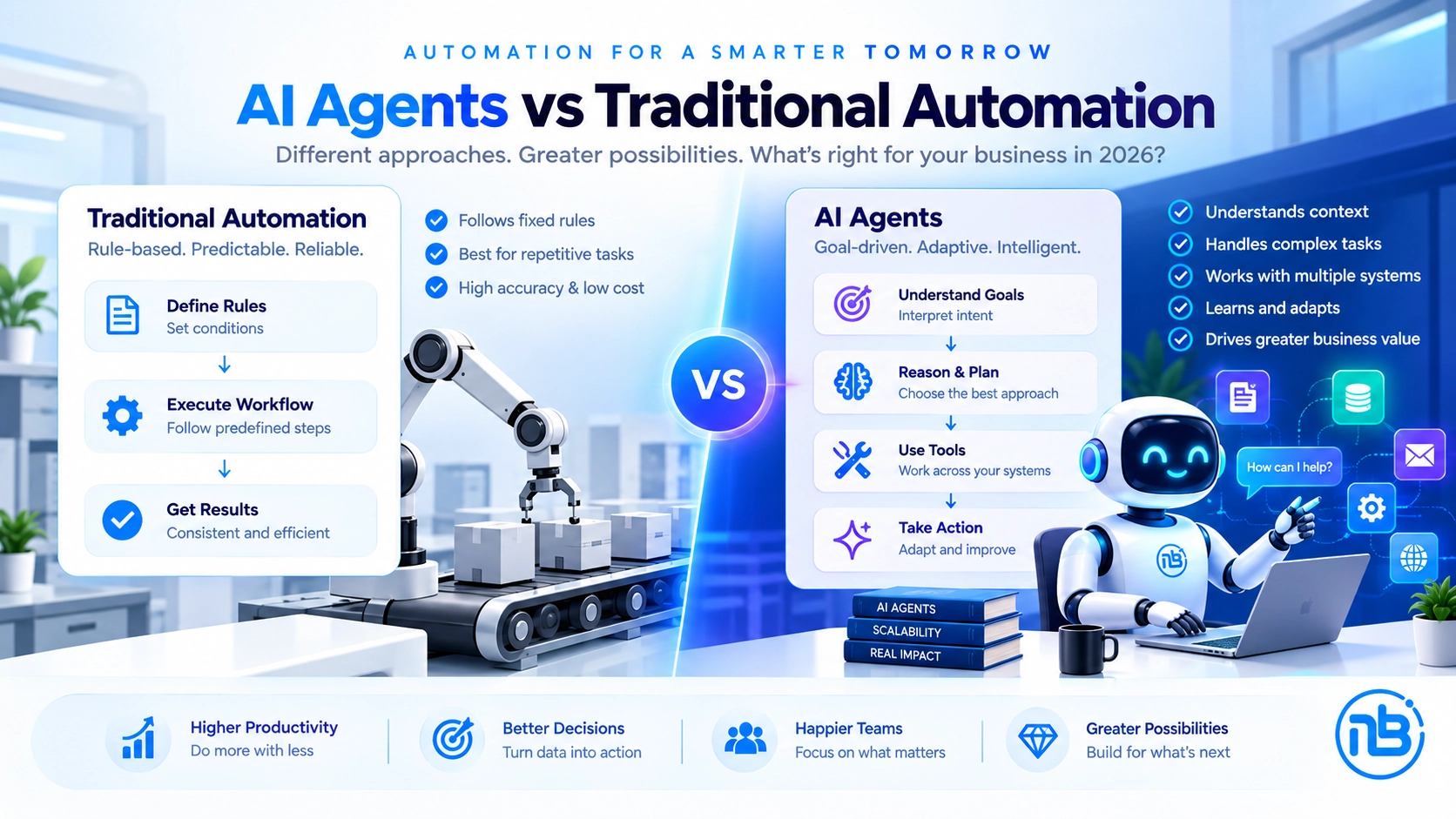
Unlike conventional automation that primarily follows predefined paths, AI agents can interpret information, reason about a goal, choose appropriate tools, perform multiple steps, evaluate results, and adapt what they do next.
This creates an important question for organizations planning automation initiatives:
Should we use traditional automation, AI agents, or a combination of both?
The answer is rarely “replace everything with AI agents.”
Traditional automation remains better for many predictable, high-volume processes. AI agents become valuable when workflows involve ambiguity, unstructured information, changing conditions, or decisions that cannot easily be represented through hundreds of fixed rules.
The most effective enterprise architecture will often combine the two.
This article explains the difference between AI agents vs traditional automation, their costs and risks, where each approach works best, and how businesses can decide what to implement in 2026.
What Is Traditional Automation?
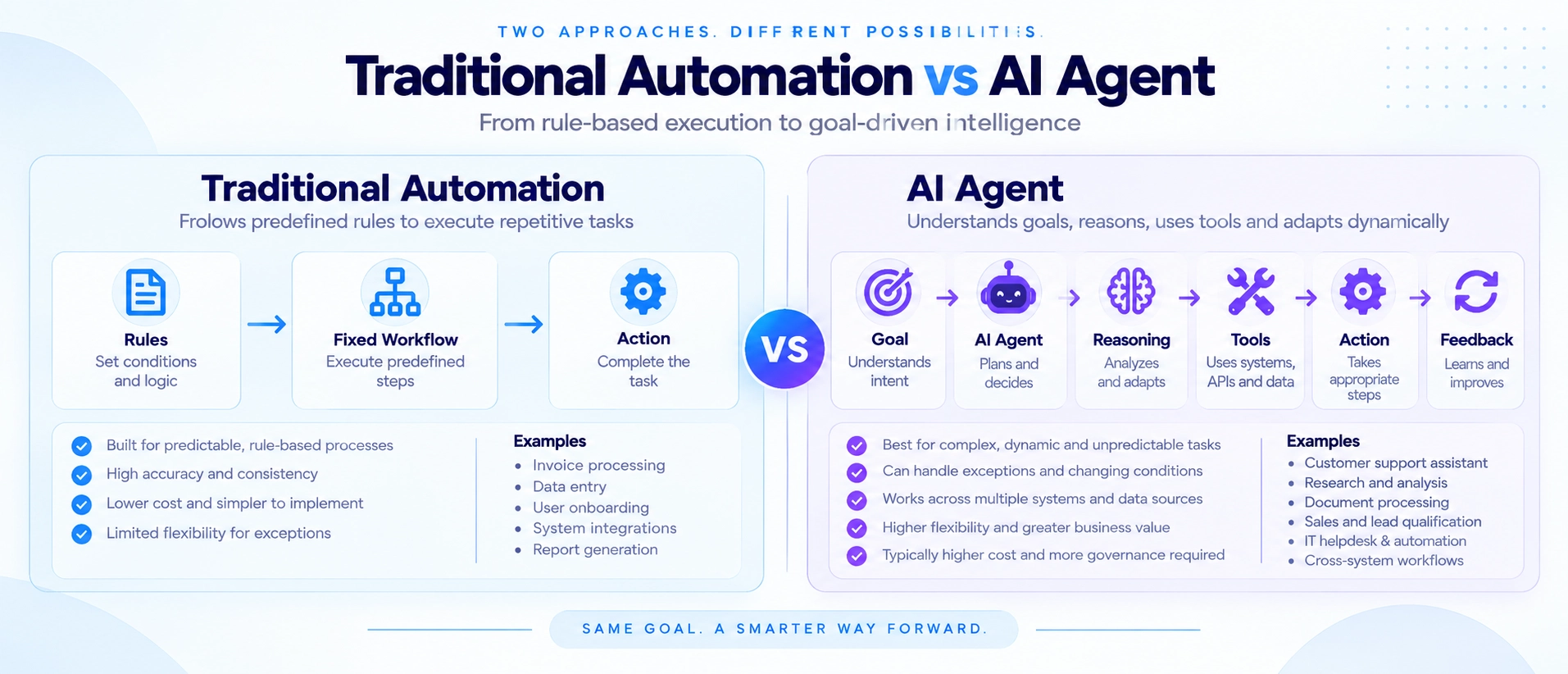
Traditional automation uses predefined rules and workflows to perform tasks automatically.
Consider a simple invoice approval process.
A company might create rules such as:
Invoice Received → Validate Required Fields → Check Amount → Select Approver → Send Approval Request → Update ERP
The application knows exactly what should happen at every stage.
This type of automation can be implemented through:
- Business applications
- Workflow engines
- APIs
- Scheduled jobs
- Robotic Process Automation (RPA)
- Integration platforms
- Custom software
- Business Process Management systems
Traditional automation works particularly well when the process is structured, repeatable and predictable.
For example:
If an invoice is below ₹50,000, send it to Manager A.
If it exceeds ₹50,000, send it to Manager B.
The system does not need to understand why. It simply executes the rule.
What Is Workflow Automation?
Workflow automation is a broader approach to connecting multiple tasks into an automated business process.
For example, when a new lead enters a CRM:
Lead Created → Assign Salesperson → Send Email → Create Follow-Up Task → Notify Sales Manager
Each step can interact with a different system.
Workflow automation can become sophisticated, but the fundamental principle remains the same:
Developers or administrators determine the workflow in advance.
If something unexpected occurs outside those predefined conditions, the workflow usually requires another rule, exception path, or human intervention.
What Is an AI Agent?
An AI agent approaches automation differently.
Rather than receiving a rigid sequence of every action it must perform, an agent can be given a goal, access to approved information and tools, and rules defining what it is allowed to do.
It can then determine how to work toward that goal.
Anthropic describes agents as systems where an AI model dynamically directs its own processes and tool usage rather than following a completely fixed script.
Imagine telling an AI sales agent:
Review today’s new leads and identify the opportunities that require immediate attention.
The agent could potentially:
- Retrieve new leads from the CRM.
- Examine lead information.
- Review previous interactions.
- Search relevant account information.
- Evaluate buying signals.
- Prioritize opportunities.
- Prepare a summary.
- Recommend next actions.
- Create follow-up tasks after obtaining appropriate approval.
The exact path may vary depending on what the agent discovers.
That adaptability is the fundamental difference.
AI Agents vs Traditional Automation
| Capability | Traditional Automation | AI Agents |
|---|---|---|
| Execution | Predefined workflow | Goal-oriented execution |
| Decision Logic | Rules and conditions | Contextual AI reasoning + rules |
| Input | Primarily structured | Structured + unstructured |
| Workflow | Mostly fixed | Can adapt dynamically |
| Natural Language | Limited | Strong |
| Unexpected Situations | Requires exception rules | Can potentially interpret context |
| Tool Usage | Predetermined | Can select approved tools |
| Predictability | High | Lower than deterministic automation |
| Cost per Task | Often lower | Usually higher |
| Governance Complexity | Lower | Higher |
| Best For | Repetitive processes | Complex, variable processes |
| Human Oversight | Exception-based | Often important for consequential actions |
The key distinction is not simply automation versus AI.
It is:
Predefined execution versus controlled autonomous decision-making.
A Simple Example: Customer Support
Suppose a customer sends this message:
We were charged twice last month. I contacted your team earlier but haven’t received a resolution. Can someone please fix this?
Traditional Automation
A conventional workflow could detect keywords such as “charged” or “billing” and create a ticket for the finance team.
The workflow might be:
Email Received → Identify Category → Create Ticket → Assign Finance Team → Send Confirmation
This is predictable and efficient.
But resolving the issue may still require an employee to investigate multiple systems.
AI Agent
A properly authorized AI agent could potentially:
Understand Complaint
↓
Retrieve Customer Account
↓
Review Previous Support Ticket
↓
Check Transaction History
↓
Identify Possible Duplicate Payment
↓
Retrieve Refund Policy
↓
Recommend Resolution
↓
Request Human Approval
↓
Execute Approved Action
The agent is not simply moving information between systems.
It is helping determine what should happen next.
When Traditional Automation Is the Better Choice
The arrival of AI agents does not make traditional automation obsolete.
In many situations, traditional automation is actually the better engineering decision.
1. The Process Is Completely Predictable
If the workflow has clear rules, there is little benefit in asking an AI model to decide what happens.
Example:
Payment Received → Generate Receipt → Email Customer
A deterministic workflow is simpler.
2. Accuracy Must Be Deterministic
Financial calculations, access-control decisions and certain compliance processes should not depend unnecessarily on probabilistic model outputs.
Traditional application logic remains appropriate.
3. Very High Transaction Volumes
If millions of simple operations must be processed, calling an LLM for every transaction may introduce unnecessary cost and latency.
4. Strict Auditability
When every decision must map directly to an explicit business rule, deterministic workflows are easier to explain and reproduce.
5. Simple System Integrations
If the requirement is simply:
CRM Update → Create ERP Record
you probably need an API integration, not an AI agent.
When AI Agents Make More Sense
AI agents become more interesting when the workflow cannot easily be expressed as a predictable decision tree.
1. Working with Unstructured Information
Businesses contain enormous amounts of information inside:
- Emails
- PDFs
- Contracts
- Customer conversations
- Reports
- Knowledge bases
- Support tickets
- Meeting notes
Agents can use Large Language Models and retrieval systems to interpret this information before deciding what to do next.
2. Multi-Step Research
Consider vendor onboarding.
An agent might need to:
- Read submitted documents
- Identify missing information
- Retrieve vendor records
- Compare submitted details
- Check internal policies
- Prepare an assessment
- Ask the employee for missing information
The exact sequence depends on what it discovers.
3. Workflows with Many Exceptions
Traditional workflows can become difficult to maintain when there are hundreds of conditional branches.
AI can potentially interpret some of those situations contextually while deterministic business rules continue controlling critical decisions.
4. Cross-System Business Processes
Modern AI agents can interact with multiple enterprise systems through APIs and tools.
A sales agent might interact with:
CRM + Email + Calendar + Knowledge Base + ERP + Analytics
Agents can coordinate information across those systems while working toward a defined goal.
This increased ability to operate across systems is also why security becomes significantly more important. Microsoft recommends treating agents as identities with explicitly scoped roles, permissions and tool access rather than giving them broad enterprise access.
Where AI Agents Can Be Used in Business
Sales
An AI sales agent could:
- Research leads
- Summarize customer interactions
- Identify opportunities
- Recommend follow-ups
- Prepare meeting briefs
- Draft personalized communication
- Update CRM information
A human salesperson can remain responsible for relationship-building and important commercial decisions.
Customer Support
Agents can combine customer history, support tickets, product documentation and knowledge bases to investigate customer issues.
They can potentially resolve routine cases while escalating unusual or sensitive situations to employees.
Human Resources
An HR agent could assist employees with:
- Policy questions
- Leave information
- Benefits
- Onboarding
- Internal documentation
- HR requests
For example:
I’m travelling internationally for a client meeting next week. What expenses can I claim?
The agent could retrieve the appropriate company policy and provide a contextual answer.
Finance
AI agents can assist with:
- Invoice analysis
- Expense review
- Financial document processing
- Reconciliation investigations
- Reporting
- Vendor queries
However, financial actions should have carefully designed authorization and approval controls.
IT Support
An IT agent could:
Receive Problem → Diagnose Issue → Search Knowledge Base → Check System Information → Recommend Fix → Create/Update Ticket
For approved low-risk scenarios, some remediation steps could potentially be automated.
Document-Heavy Operations
Agents combined with OCR, RAG and document intelligence can process invoices, contracts, forms and other business documents.
The agent could determine document type, extract information, retrieve relevant policies and route the document appropriately.
AI Agents Do Not Need Complete Autonomy
This is one of the most important points for businesses considering agentic AI.
An AI agent does not need permission to perform every action independently.
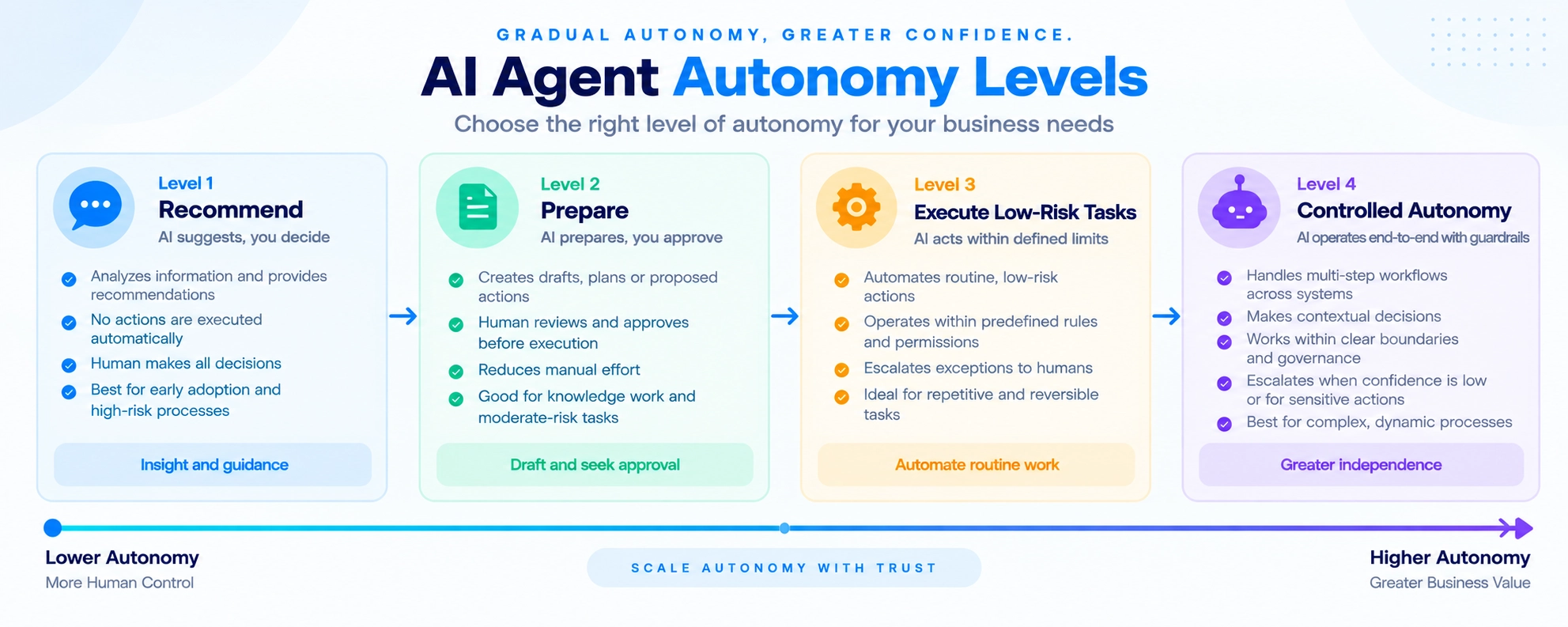
There are several possible levels of autonomy.
Level 1 AI Recommends
The agent analyzes information but an employee performs the action.
Level 2 AI Prepares
The agent prepares an action and asks the user to approve it.
Level 3 AI Executes Low-Risk Actions
Routine, reversible operations are automated while sensitive actions require approval.
Level 4 Higher Autonomy
The agent executes broader workflows within clearly defined boundaries.
For most organizations beginning with AI agents, controlled autonomy is a more sensible starting point than unrestricted autonomy.
IBM’s 2026 discussion of agentic enterprises similarly notes that organizations are often deploying agents in narrow use cases with guardrails and human oversight rather than immediately handing over core end-to-end processes.
What Do AI Agents Cost?
AI agents are not necessarily cheaper than traditional automation.
They may introduce additional costs for:
- LLM/API usage
- Infrastructure
- Agent orchestration
- RAG/vector search
- System integrations
- Security
- Monitoring
- Evaluation
- Observability
- Development
- Maintenance
Agents can also perform multiple model calls while completing a single task.
For example:
Understand Request → Search → Reason → Call Tool → Evaluate Result → Search Again → Generate Response
This means a single agent task can consume substantially more AI resources than a simple chatbot request.
Anthropic recommends starting with the simplest architecture that solves the problem because agentic systems can trade increased latency and cost for better performance on complex tasks.
Therefore, the correct question is not:
How much does an AI agent cost?
It is:
Does automating this business process create more value than the total cost of operating the agent?
The Risks Businesses Need to Understand
The autonomy that makes AI agents powerful also creates additional risks.
Hallucinations and Incorrect Reasoning
AI models can produce incorrect information.
If an AI assistant generates an inaccurate answer, a user may notice and correct it.
If an autonomous agent acts on incorrect reasoning, the consequences can be more significant.
Prompt Injection
An agent may process emails, documents, websites and other external content.
Malicious instructions can potentially be embedded within that information to influence the agent.
Microsoft specifically identifies indirect prompt injection as a concern when agents consume external data and have permissions to perform actions.
Excessive Permissions
Imagine an AI agent that can:
- Read emails
- Access CRM records
- Modify ERP information
- Read company files
- Send messages
Individually, each permission may appear reasonable.
Combined, they can create substantial authority.
Least-privilege access is therefore especially important for agentic systems.
Accountability
Organizations need to know:
- Who requested the action?
- Which agent performed it?
- What information did it use?
- Which tool did it call?
- What was changed?
- Who approved the action?
Auditability needs to be part of the architecture.
Evaluation Is More Difficult
Traditional software can often be tested against predictable inputs and outputs.
Agents are harder to evaluate because they may take different paths to accomplish the same objective.
Anthropic notes that multi-turn operation, tool calls and adaptation make agent evaluation more complex, making dedicated evaluations important before and after deployment.
The Better Enterprise Approach: Hybrid Automation
For many businesses in 2026, the answer is not:
AI Agents OR Traditional Automation
It is:
AI Agents + Traditional Automation
Use AI where interpretation, reasoning and flexibility are valuable.
Use deterministic software where predictability, validation and control are essential.
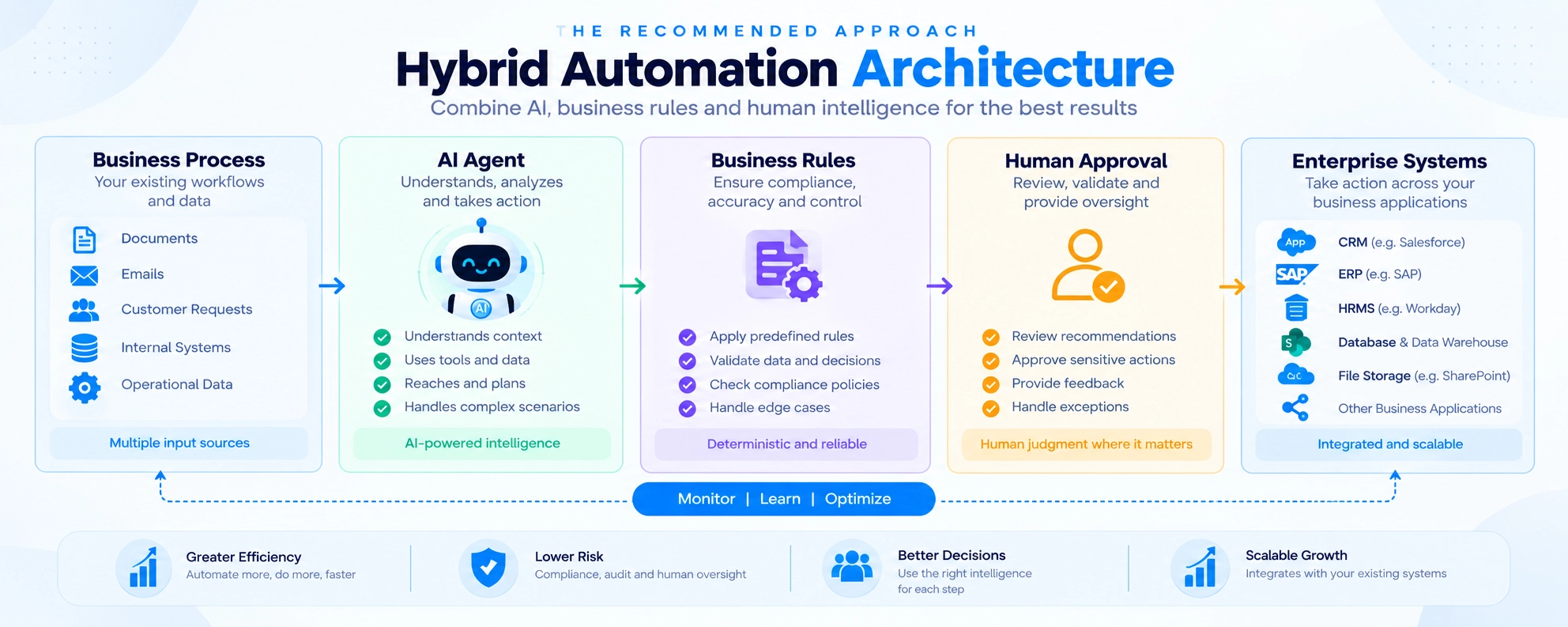
Consider an invoice-processing system.
AI
Read the invoice.
↓
AI/OCR
Extract information.
↓
AI Agent
Investigate an unusual description.
↓
Business Rule
Validate GST/tax fields.
↓
Deterministic Workflow
Check approval threshold.
↓
Human
Approve high-value payment.
↓
API Automation
Update ERP.
This architecture uses different technologies for what each does best.
The AI does not need to control the entire process.
A Practical Decision Framework
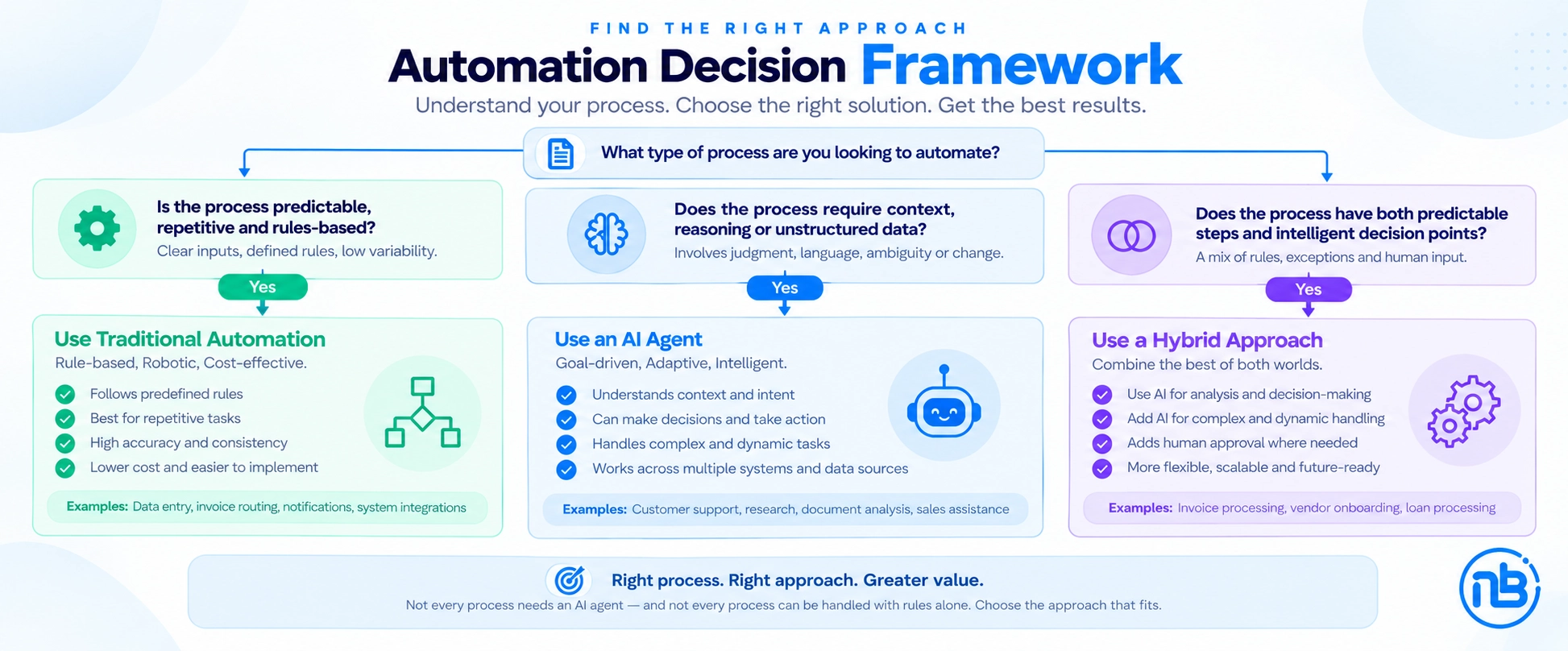
Before deciding whether to build an AI agent, ask these questions.
Is the process predictable?
Yes → Traditional automation may be enough.
Does it involve significant unstructured information?
Yes → AI may add value.
Does the workflow frequently change depending on context?
Yes → Consider an agent.
Are decisions governed by strict rules?
Yes → Keep those decisions deterministic.
Does the process span multiple systems?
Yes → Workflow automation or an AI agent may help, depending on complexity.
Can an incorrect action create significant financial, legal or operational consequences?
Yes → Introduce approval controls and limit autonomy.
Can the problem be solved with a simple workflow?
Yes → Don’t build an agent just because you can.
That final question is particularly important.
How Businesses Should Start with AI Agents in 2026
Instead of attempting company-wide autonomous automation immediately, start with one clearly defined process.
A practical roadmap is:
1. Identify the Business Problem
Choose a workflow where employees spend significant time interpreting information or coordinating multiple systems.
2. Map the Existing Process
Understand applications, APIs, permissions, decisions, exceptions and human approvals.
3. Separate Deterministic and Intelligent Tasks
Determine which steps require AI and which should remain rule-based.
4. Define Agent Permissions
Specify exactly which data and tools the agent can access.
5. Build a Controlled Prototype
Test the agent against realistic scenarios before giving it production access.
6. Introduce Human Approval
Require approval for consequential actions.
7. Evaluate the Agent
Measure accuracy, task completion, tool selection, failure cases, cost and latency.
8. Deploy Gradually
Begin with a limited group of users or low-risk workflow.
9. Monitor Continuously
Production agents should be monitored because their interactions, tools, models and business environments can change. Microsoft and IBM both emphasize ongoing governance and monitoring as agent deployments move into real enterprise workflows.
AI Agents vs Automation: What Should You Choose?
The simplest answer is:
Choose traditional automation when the process is predictable.
Choose AI agents when the process requires interpretation and adaptability.
Combine both when the workflow requires intelligence as well as deterministic control.
Businesses should not replace reliable automation simply because agentic AI is newer.
A workflow that has operated accurately for five years does not automatically become better because an LLM is added to it.
At the same time, businesses should recognize that AI agents can automate categories of knowledge work that were previously extremely difficult to represent using traditional workflow rules.
The competitive opportunity lies in understanding where each technology belongs.
The Future of Business Automation Is Intelligent—but Controlled
Traditional automation transformed businesses by allowing software to perform predictable repetitive tasks.
AI agents expand that possibility to workflows involving language, context, reasoning and dynamic decision-making.
But greater autonomy creates greater responsibility.
The organizations that benefit most from AI agents will likely not be those that give AI the most control.
They will be organizations that design the right level of autonomy for each business process.
That means combining:
AI reasoning + deterministic business rules + secure integrations + human oversight.
In 2026, that is a much more practical enterprise strategy than trying to make every workflow fully autonomous.
How We Approach This at Notebrains
At Notebrains, we approach AI automation from the business process first—not from the assumption that every organization needs an AI agent.
We begin by understanding your existing applications, workflows, data sources, integrations, business rules, security requirements and operational challenges.
We then identify which parts of the process are best handled through:
- Traditional workflow automation
- API integrations
- Generative AI
- Retrieval-Augmented Generation (RAG)
- AI agents
- Intelligent document processing
- Machine learning
- Human approval workflows
For predictable processes, we may recommend conventional automation rather than unnecessarily introducing AI complexity.
For workflows involving documents, natural language, multiple systems, contextual decisions or complex exceptions, we can design controlled AI agents that work alongside your existing applications.
Our solutions can integrate technologies such as OpenAI, Azure AI, Gemini, Claude, Llama, LangChain, LangGraph, Python, Node.js, React, enterprise APIs, RAG systems and existing databases or applications.
The goal is not maximum automation.
The goal is the right automation—secure, scalable, measurable and aligned with your business.
Ready to Explore AI Agents for Your Business?
If you’re evaluating whether an existing workflow needs traditional automation, an AI agent, or a hybrid architecture, Notebrains can help assess the process and design the right implementation approach.
Frequently Asked Questions
Traditional automation primarily executes predefined workflows and rules. AI agents can interpret context, select approved tools and dynamically determine steps toward a goal.
Not necessarily. Deterministic automation remains highly effective for predictable processes. AI agents are better viewed as an additional automation capability for workflows requiring interpretation and flexibility.
They can be. Agentic systems may require multiple model calls, integrations, retrieval infrastructure, monitoring, security and evaluation. Cost should therefore be evaluated against the business value generated.
Yes, where suitable APIs or integration mechanisms exist. Agents can be connected to CRM, ERP, HRMS, document management and other enterprise systems while those applications remain the systems of record.
They can be designed with strong controls, but they introduce additional risks because they may access data and perform actions. Authentication, least-privilege permissions, tool restrictions, audit logging, evaluations and human approvals are important safeguards.
No. Businesses should use agents where their adaptability creates measurable value. Simple, predictable processes are often better served by conventional software and workflow automation.